Archive for the '05 Uphill' Category

Skin Set Up - Part Two

Now that the edges have been trimmed back and the nose has been set, I like to tweak my tails a bit (the tails of the skins that is).

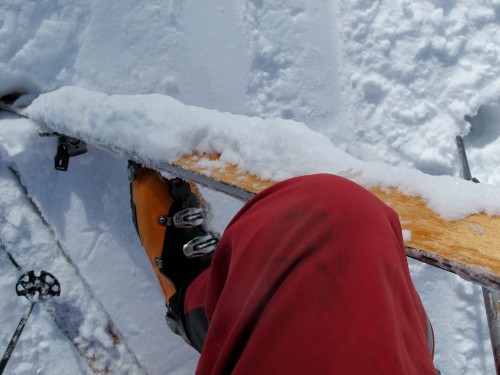
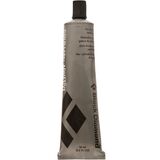
Although I designed the BD ClipFix and used that system for years, I’ve now gravitated towards the STS system (shown below).  I liked the ClipFix, but as Martin Volken said about it, “It’s an expert system.” meaning if you spent the time to get it perfectly dialed, it worked great, but if not, they’d fall off. I didn’t mind getting mine dialed in, but that often meant widening the tail slot, which is/was kind of a pain.  The STS system is not only totally bomber, but it fits most of the standard issue tail notches.  If you don’t have a notch, most skis can stand one being filed/cut in and it makes a huge difference in keeping your skins on.

I use a pair of Channel Lock pliers to crimp the camming cleat down to a lower profile (less chance of it getting hung up on things) and then thread the tail back through the tip, as shown above.  Tucking the tail up makes for cleaner, faster uphill kick-turns where you are less likely to step on your tail dingle.  Plus I hate having those things flapping around.

As a final skin set-up step, I keep the skins attached to the appropriate ski with a Voile strap so I never grab the wrong skins, or worse yet, forget them, when heading out the door for a big powder day.


________________________________
Help support StraightChuter.com and pick up a pair of the light & compact Black Diamond GlideLite Nylon STS Skins from Backcountry.com. Click on the photo below…

Skin Set Up - Part One

I’m the first to admit that I’m anal-retentive when it comes to setting up my skins.  Why? Because spending an hour or so in the beginning getting your skins just right means you never have to fool with them again and that they seldom fall off or fail in the field.  I can’t remember the last time I had a skin failure.  Once skins are properly trimmed and adjusted, they can take all sorts of abuse, such as walking across rocks, asphalt and logs.

One of the most important parts of trimming out a pair of skins is to hold them back about 3/16″ from the edges.  Many people just trim them “neat” to the edges (as much out of laziness as anything), but that makes it much harder to get the skins on the ski and you lose your sharp edge when you need it on firm snow.  The tiny bit of extra grip you’ll get by going wall-to-wall is irrelevant compared to the problems it causes.

To trim the edge back, first trim it “neat” to the edges, then move the skin over so about 3/16″ of an inch is hanging over, trim it off, then do the other side.
An expert skier/skinner with full-width skins being humbled into a self arrest on an icy slope as he couldn’t sink an edge in. I’m glad you were okay Steve. ;)

On the tip, if I think there is any chance I might adjust the length of the skin, I use a rounded end.  This gives a bit more adhesive-to-adhesive contact, plus it allows the sides of the skin to grip a bit more, which helps to keep snow from packing in there (the beginning of the end).  As most of my skis have dedicated skins, I cut the tip off short and sew it tight with some beefy thread.  This ensures that the tip loop never comes off, gives a nice smooth contact profile to the skin and saves a bit of weight & bulk.

On skins which are dedicated to a certain pair of skis, I cut the nose short, then stitch it on as shown on the left. On skins that may change skis, I trim the nose with a half circle (as shown on the right).

________________________________
Help support StraightChuter.com and pick up my current skin of choice, the Black Diamond Ascension Nylon STS Skin from Backcountry.com. Click on the photo below…

Pick Your Poison – Methods of Ascent (part II)

Learning to skin is like learning the alphabet-something you have to do before you start spelling words or linking tours together.  It’s a lot like walking, but a bit different. Booting is walking, but unless you are on firm snow, your range will be severely limited as nothing saps your energy like post-holing in deep snow.  Snowshoes can be learned via The Twelve Step Program (take twelve steps - now you are an expert), but they lack any sort of glide and don’t climb very well, or if they do, then they don’t float very well.  Snowshoes are popular with snowboarders, but eventually, if the boarder is serious about getting deep into the backcountry, she’ll switch over to approach skis or split boards.
Skin if you can... boot if you must.  Greg VonDoersten punching out the final feet to the summit of Mt. Damavand, Iran.
Skin if you can… boot if you must. Greg “GVD” VonDoersten punching out the final feet to the summit of Mt. Damavand, Iran.


Skinning is the most complicated method of the three, as it requires not only the skins, but a touring binding as well and a tad of technique. Still, these are very small prices to pay if you are planning on touring more than once or twice.

________________________________
Help support StraightChuter.com and be like GVD with a Patagonia Beanie from Backcountry.com! Click on the photo below…

Pick Your Poison – Methods of Ascent

For ski mountaineering, there are three main methods of traveling over snow; skinning, booting or snowshoeing.  Of these three, skinning is by far and away the most efficient and versatile.  Booting works well when there is an existing boot track, or when the going gets steep.  Snowshoes are better than crawling, but not by much.  Regardless of which method you choose, a critical factor is that everyone in your group uses the same system as the pace and route selection is radically different with each one.  A skin track will wander much more than a boot track and snowshoes will be somewhere in-between.  If you find yourself in a mixed group, the first discussion you should have is where, or if, you will regroup when your party gets separated, because they soon will. 
Birds of a skinning feather... stay together.  Sol Mountain Lodge, Monashees, BC
Birds of a skinning feather… stay together. Sol Mountain Lodge, Monashees, BC


Continued tomorrow…

 ________________________________
Help support StraightChuter.com and get the vertical munching Ascension Nylon STS Skins from Backcountry.com! Click on the photo below…

Winning the Uphill Battle - Part III

Efficient ascents are a blend of pacing, route finding, technique and equipment.  Like rolling a ball uphill, your approach to skinning should vary according to conditions and terrain, but the underlying idea is to find the most expedient way possible, while not losing any ground. 

Skinning isn't always about mellow 12 degree shuffling.  The fastest way to the top is to use whatever method works best.
Skinning isn’t always about mellow 12 degree shuffling. The fastest way to the top is to use whatever method works best.

Sometimes this means using brute force and sometimes it requires endless finesse.  There is no one method of ascent which is always the best, instead it is a constantly shifting selection and the fastest skiers are those who adapt to whatever it takes.

________________________________
Help support StraightChuter.com and get 15% off on the vertical tracking Suunto Altimax Altimeter Watch from Backcountry.com! Click the photo below…

Winning the Uphill Battle - Part II

continued from yesterday…

A good way to learn is to follow in the footsteps (or more likely, skin tracks) of more experienced skiers.  Try to match their stride, look where they plant their poles, get a feel for the all day ascent angle, mimic their posture, and generally try to absorb what they are doing, while of course maintaining a safe distance from their tails.  It is kind of like uphill osmosis.  If you don’t have someone to learn from, see if you can pick out clues from a pre-broken trail.  Ascending is only boring if you make it that way.  Instead, be active and involved — think about  improving and getting more efficient, not just plodding along. 

If you can stay focused and engaged, skinning is fun in the same way as friction climbing.  Armond, Weedy and Lorne punching it out up Thunder Mountain.
If you can stay focused and engaged, skinning is fun in the same way as friction climbing. Armond, Weedy and Lorne punching it out up Thunder Mountain.

I had the misfortune of learning how to skin from Alex Lowe.  Like most people who went out with him, I was overwhelmed just trying to keep up, let alone do any trail breaking.  Among our small group, we’d try to figure out strategies to keep from getting dusted by Alex, like carrying less weight, starting out with less clothing on, getting plenty of sleep, strapping water bottles to our waistbelts, always climbing with one heel lifter setting and many other futile tricks that never seemed to help.  What finally did help was when Alex won an international alpine speed climbing championship, as it made me realize it was pointless to try and keep up with him, so I slowed down and started developing my own pace, which over time has increased.  Skinning is one of those activities where you get faster by starting out slow, both in the long and short term.  The real (and only) secret to speedy climbing it is to do it a lot.

tomorrow - part III

________________________________
Help support StraightChuter.com and get 15% off on the super-sticky Black Diamond Glidelite Nylon Skins from Backcountry.com! Click the photo below…
 

Winning the Uphill Battle - Part I

Struggling uphill is an acquired taste that doesn’t come naturally to most people.  It’s hard, slow, sweaty, frustrating and at times monotonous, but if you can get over this, it is your ticket to backcountry bliss. The effort involved with earning your turns is the basic barrier that keeps the backcountry, being what it is - uncrowded. With time and practice, it not only gets easier, but often can be even more enjoyable than the downhill.  Really. 

Julia Niles smiling through the pain.

Ascending is a mindset.  When you stop fighting it and learn to love it, everything just starts to flow uphill.  For many skiers, including myself, this is the magic moment when you suddenly “get” backcountry skiing, as it becomes much less work and a lot more fun.  How soon you reach this point depends on how hard you work at it, and the more you do it, the easier it gets.  Before long, the only high speed quads you’ll need will be your thighs, not the chairlift.  Embrace the burn, seek purification through perspiration and learn the true meaning behind “that which does not kill you, makes you stronger.”  Skinning is fun.

On a more practical note, eighty percent of your time in the backcountry will be spent ascending, so it is worth coming to terms with it.  Think of the uphill as the skiing and the downhill as the icing on the cake.  When the going gets really grim, remember, the harder it is going up, the better it is going down.

________________________________
Help support StraightChuter.com and get 15% off on a Julia Niles style Mountain Hardwear Synchro Pants from Backcountry.com! Click the photo below…