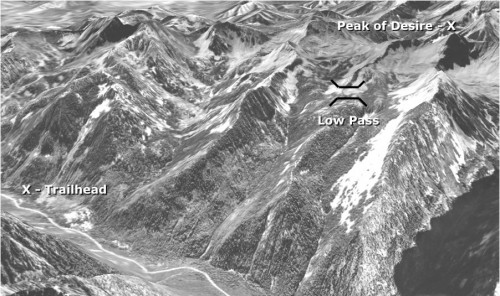
To layout a tour, begin with the basics–where you are starting from and where you want to go. Next, mark out any passes that lay between these two points.

The first steps to laying out a day tour begin with a trailhead, an objective and any low or safe spots in between.
Next, identify (and avoid) any steep avalanche terrain. Going up is a slow process and it is important to minimize your time in the “strike zone.”

Identify steep avalanche terrain… and avoid it whenever possible.
Third, look for low, safe ground leading up to your high point.

Once the basics passes, dangerous spots and low angle terrain has been indentified, layout a route.
Forth, identify any areas where steep, exposed terrain is unavoidable and correlate these areas with your avalanche observations. If the snow seems unstable, find a safer route up the Peak du Jour, or modify your plans.

Identify trouble spots - almost every tour has a few of them and they are where almost all accident happen.
Once you have marked out these options, creating a day tour is a matter of connecting the dots between trailheads, valleys, passes and summits. This is a simplified version of the process, but it is a start. From here, you need to “fact check” your route to see if the terrain you’ve chosen is skiable, or a huge cliff. This is done by measuring the contour lines, or looking at photos. Postcards are often some of the best aerial photos available and not only that, they are cheap, travel well and you can mail them when you are done.
______________________
Click the image below for 15% off on a Mountainsmith Flash Camera bag from Backcountry.com, which is perfect for keeping your camera handy for future reference photos.

“Never take no cutofs and hurry along as fast as you can.”
Virginia Reed, thirteen-year-old survivor of the cannibalistic Donner/Reed party. 1847
Getting lost in the mountains is a time honored tradition. Teton climbing guidebook author, Leigh Ortenburger, once said “I’m not publishing any more new routes where people just got lost!” As long as there’s a happy, safe ending, getting lost in the mountains is merely a state of mind. You can’t be lost if you don’t care where you are going.

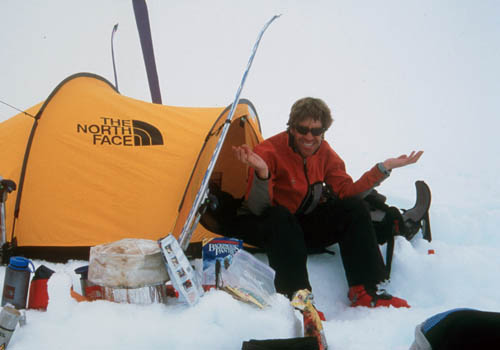
Going nowhere fast. The leaky tent was trival compared to the lack of a good map and endless white-out conditions. Antarctic Penninsula
But most of the time we do care where we are going. In familiar terrain on a clear day, navigation is as easy as Point & Chute-you see it, then you ski it. In poor weather, unfamiliar terrain or after you have been benighted, the stakes go way up and it becomes Navigation Skills or Hospital Bills. Navigation is an ancient art that is best learned when you least need it, like on a nice clear day instead of in a torrential downpour in the dark.
Navigation for its own sake is fun. The act of planning an outing on a two dimensional surface and then seeing it unfold exactly as intended (hopefully) in reality is magical. An important aspect of learning to navigate is to enjoy it, and in turn, a big part of enjoying it is doing it yourself. Following someone else’s tracks through the mountains will help develop your mountain travel skills, but not your navigation skills.
Getting lost is easy. Staying found is not.
______________________
For 15% off on National Geographic TOPO! Maps from Backcountry.com, click the image below…