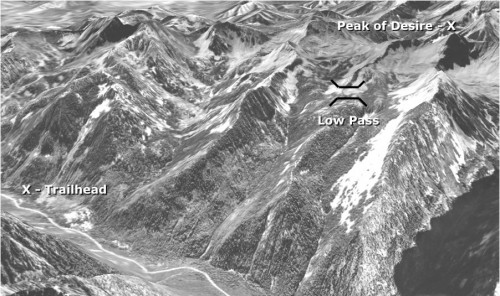
To layout a tour, begin with the basics–where you are starting from and where you want to go. Next, mark out any passes that lay between these two points.

The first steps to laying out a day tour begin with a trailhead, an objective and any low or safe spots in between.
Next, identify (and avoid) any steep avalanche terrain. Going up is a slow process and it is important to minimize your time in the “strike zone.”

Identify steep avalanche terrain… and avoid it whenever possible.
Third, look for low, safe ground leading up to your high point.

Once the basics passes, dangerous spots and low angle terrain has been indentified, layout a route.
Forth, identify any areas where steep, exposed terrain is unavoidable and correlate these areas with your avalanche observations. If the snow seems unstable, find a safer route up the Peak du Jour, or modify your plans.

Identify trouble spots - almost every tour has a few of them and they are where almost all accident happen.
Once you have marked out these options, creating a day tour is a matter of connecting the dots between trailheads, valleys, passes and summits. This is a simplified version of the process, but it is a start. From here, you need to “fact check” your route to see if the terrain you’ve chosen is skiable, or a huge cliff. This is done by measuring the contour lines, or looking at photos. Postcards are often some of the best aerial photos available and not only that, they are cheap, travel well and you can mail them when you are done.
______________________
Click the image below for 15% off on a Mountainsmith Flash Camera bag from Backcountry.com, which is perfect for keeping your camera handy for future reference photos.

Most day trips in North America are simple enough to forego detailed trip planning. If it doesn’t work out, well, you can always just follow your skin track back to the trailhead. Guidebooks and local knowledge are the best navigation tools out there, as someone has already made all of the mistakes for you. If there is a guidebook to an area, use it! That said, they can be notoriously inaccurate (like the one I wrote...) as the author may be so familiar with the terrain that they focus on minute details and leave out the large ones.

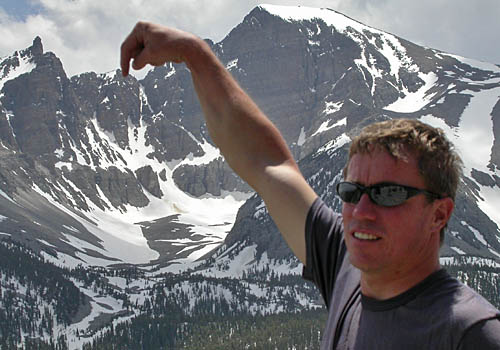
Simplicity is part of the beauty of day tours - it’s as easy as point n’ chute like the photo above. Derek Weiss pointing out the Cortex Couloir, Great Basin, Nevada.
Some areas have a strong and misguided ethic of not reporting descents, discouraging visitors, giving out false information and harassing any attempts at a guidebook. These regions are generally not nearly as good as the locals seem to think they are and it’s their loss. What goes around, comes around.
On longer tours or multi day trips, the penalty for poor planning is getting lost, benighted or suffering through poor terrain. Trip planning is not hard, but it does take time, especially to do it correctly. Maps and photographs are the basic tools of the trade and a good place to start.
______________________
For 15% off The Chuting Gallery - A Guide to Steep Skiing in the Wasatch Mountains from Backcountry.com, click the photo below…