Tag Archive for 'travel'

The Law of Luggage

The Law of Luggage states:

“The amount of gear you carry will expand to fit your luggage.”

This is closely related to the idiom that nature abhors a vacuum - if there is extra space in a pack, duffle bag or sled, it will be filled with extra gear whether you need it or not.  This causes all sorts of problems, including painful (and costly) travel logistics and immobility due to excessive weight. 

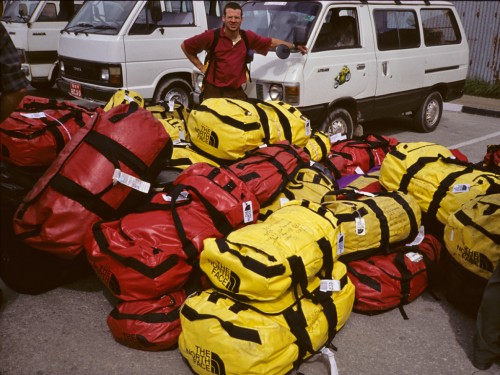
Many tons of the lightest climbing gear on earth.  I don't know why we decided to bring all this, but it made sense at the time.  Mark Holbrook, Katmandu
Many tons of the lightest climbing gear on earth. I don’t know why we decided to bring all this, but it made sense at the time. Mark Holbrook, Katmandu

The Law of Luggage applies to day packs as well as expedition duffle bags.  For backcountry skiing day trips, the best way to lighten your load and increase your mileage is to start with a small pack so you just can’t carry much to begin with.  For expeditions, especially with the new fifty pound per bag weight restrictions, those sexy oversized expedition duffles will be your worst enemy by the time you stuff them full of 110 pounds of gear, not to mention the duffle weighing eight pounds itself.  You won’t be going very far or very fast if you have to carry two of those behemoths. The fifty pound limit is actually a blessing in disguise as it encourages a tighter, lighter gear selection, which in turn means you can get by with a smaller sized duffle.

________________________________
Help support StraightChuter.com and get a MEDIUM SIZED Mountain Hardwear Expedition Duffle Bag from Backcountry.com! Click on the photo below…


Airfare Paradox of Choice

One of the most influential books I’ve read in the last five years has been “The Paradox of Choice” by Barry Schwartz.  This isn’t to say it is a rip-roaring good read, but I think about it almost every day, especially when faced with the endless morass of choices while trying to find the best deal on an airline ticket. 

The premise is simple: you would think that with more choices, people would be happier, but it is just the opposite.  As a case study, when a jelly company offered three sample flavors, people tried one or two, and then ended up buying one.  When they offered twenty-four samples, instead of trying and buying more, people were so overwhelmed with choices that they blew off the entire sampling and bought nothing.

This is where expedition airfare purchases come in.  There’s an overwhelming amount of choices to be had with endless mixtures of schedules, arrival and departure times, cost, duration, discounts, penalties, etc..  Personally, I hate it, as it is hard to know if you are really getting a good deal, especially when your cheap airline carrier charges extra for each bag, then loses them.

Mike Libecki paying the airfare paradox of choice layover penalty somewhere in
Lost in America. Mike Libecki paying the cheap airfare penalty in somewhere in the midwest.

As the “Paradox of Choice” outlines, people tend to be Optimizers or Satisfiers.  Optimizers will spend an inordinate amount of time making sure they got the absolute best deal, and then be crushed if they find something even slightly better afterwards.  Satisfiers on the other hand spend a set amount of time shopping for an item, make a purchase and then don’t look back.  This is what I try to do with airline tickets - dedicate an hour to it, make a choice, then move-on.org and don’t worry about it.  It’s the price of having fun.

________________________________
Help support StraightChuter.com and get the ultimate travel organizer bag, the Mountain Hardwear Memo Bag on sale now for 40% off at Backcountry.com! Click on the photo below…
 

Sunday Photo - Baffin Island Iceberg Camp

Editors Note: Sundays are meant for skiing, climbing, riding and almost anything but sitting in front of a computer.  Still, the Internet never sleeps and Sunday’s are a good time for ski mountaineering photos and the story behind them.

Baffin Island Iceberg Camp - 2002

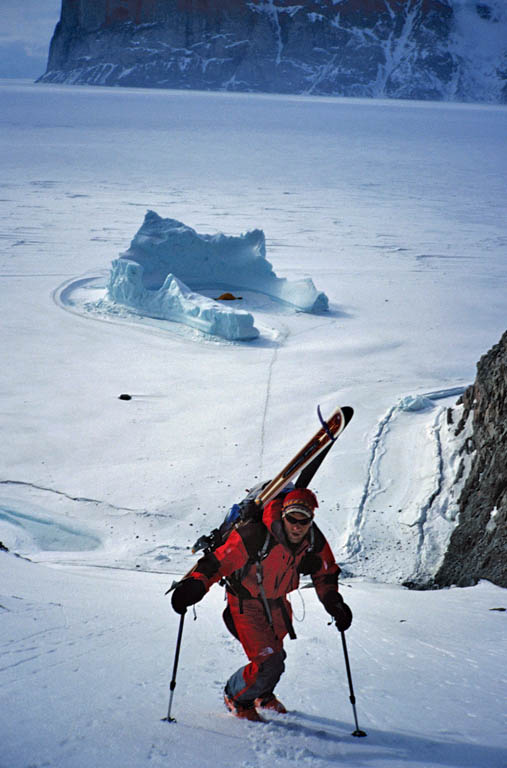
Brad Barlage booting up the Model T couloir. Baffin Island

While watching a Mike Libecki slideshow on Big Wall climbing in Baffin Island, I kept catching glimpses of tasty looking couloirs in the background of scenic photos and wondered if they were skiable.  As it turned out, most of the descents off of the huge vertical walls were by walking/sliding down nearby couloirs.  When I asked another skier/climber who had been to Baffin how many of these couloirs there were in the area, he said “Oh God! Hundreds!”  That was all the info needed to start planning a trip to the area.

In 2002, Brad Barlage and I spent four weeks in the Sam Ford Fjord area of Baffin Island doing some of the best skiing of our lives.  In this photo, we had moved camp to an area with 3-4 chutes in it and found a melted out iceberg which had drifted over from Greenland.  It’s good to camp near icebergs as they are a source of clean water for melting, but in this case, we were worried about an avalanche coming down the couloir and nailing the berg like a perfect catcher’s mitt, burying us in the process.

In the end, it was just too cool a campsite to pass up and the snow was stable enough that we spent two nights camped there.  At one point, some of the berg itself calved off and almost hit Brad, but aside from that, it was excellent.

 ________________________
15% off aluminum crampons perfect for booting up Baffin couloirs from Backcountry.com


Love Thy Bases & Bindings

Skis and bindings have a hard enough life without getting sandblasted by road salt, grit, acid rain and polluted snow while riding naked in a roof-top car rack.  Ski bases can be cleaned off, but road grime is especially damaging to bindings, and much harder to clean.  Transporting your skis inside the vehicle is the best way to keep them clean and lovely, as well as upping your gas mileage.  If they must ride shotgun on top, at least put them in a ski bag.

 Not feelin\' the love here...
Naked and exposed on top of a car - how NOT to love your skis, bindings and skins!
 
________________________
15% off ski bags from Backcountry.com


Ski Mountaineering in Iceland - Photos

In May of 2006, I joined Matt Turley, Dylan Freed, John Griber, John Armstrong and Rob Raker on a trip to northern Iceland for some ski mountaineering.  Matt Turley was the originator of this trip as he had been to Iceland in the summer to shoot photos and thought it might make for some good skiing in the winter.  He was right.  At the same time, the Producers of the movie “Steep” were looking for some backcountry footage and sent along a film crew (Griber, Armstrong and Raker). 

The weather was brutally maritime with mostly manky, cloudy, overcast, windy/snow conditions followed by brief spells of clearing.  Overall it was an excellent trip and highly recommended… just don’t forget to bring your wallet and credit cards as it is one of the most expensive places I’ve ever visited.

_________________
Iceland proven gear from Backcountry.com at 15% off:

Ready for sitting around in the rain in Iceland?  The MHW Beryllium jacket is.

 Iceland has almost every kind of fuel, except white gas.  Luckily the MSR Whisperlite International will burn unleaded gas.

Death by 1,000 Ounces

It is easier to ruin a trip by having too much gear rather than too little.  The issue with too much gear is weight, and too much weight means reduced mobility.  As Ray Jardine, the master of ultralight backpacking says “If you need something and you don’t have it, then you don’t need it.”  This may be pretzel logic, but it is the thought that counts.  At best, cold-weather ski mountaineering is a heavy prospect, so don’t make it worse than it already is.

How much is too much?  It depends, but if you are packing for a trip find yourself thinking “Oh, this doesn’t weigh too much… I’ll just bring it.” you can probably do without it.

 Ben Ditto preparing for pain in Patagonia.
Ben Ditto (140 lbs) with a 100 lb pack on the Southern Patagonia Ice Cap.  Pure misery.

_______________________________________________________

Lightweight gear from Backcountry.com at 15% off:

The ultimate stuff sack - light, durable and it works.


At .5 ounces, this titanium spork will make you very, very sexy…

One for the Road

One of my favorite pieces of travel advice came from a hokey little magazine article about family road trips, but the advice is applicable to ski mountaineering trips or expeditions as well. The basic idea is to force yourself (and your partners) to spend one minute of contemplation before you take off going through a list of things you need to bring. Skisbootspoleshatglovesgogglesmoneydrugsfood?

Prepping for a trip always takes longer than expected and often ends with a last second dash for the car, squealing wheels and a mad rush out the door. It is only when you are twenty minutes down the road that you remember that your wallet/boots/jacket are right where you left them… safely back at the house.

Now you have to turn around, go all the way back, then back again, which makes you REALLY late.

The trick is to nip the panicked exit before it begins, which is right as the car key is heading for the ignition. Put the key down, look at the clock and force yourself to think for a full minute before you begin. The minute you spend could save you hours afterwards.

_________________________
Click the bag for 15% off from Backcountry.com on a burly MHW duffle.

The Last Word on First Aid

First Aid and CPR classes are like classic literature—everyone agrees they are great, wonderful and important, yet few people have actually made it all they way through them.  Skiers are optimists and the chances of ever actually having to perform CPR or First Aid are remote, which makes it easy to blow the classes off.  However, the real importance of CPR and First Aid classes is not so much in learning the mechanics of chest compressions and how to bandage a severed stump, but more that the classes force you to think about emergency situations in advance, so that when accidents do happen, you can provide aid with increased confidence.  You’ve seen it before, thought about it, been tested on it and even if you forgot most of it, the increased confidence and calm will be invaluable.

Cardiopulmonary resuscitation (CPR) is most often associated with heart attack victims where it is marginally successful.  In terms of ski mountaineering, where CPR really shines is in resuscitating avalanche burial victims and restarting a person’s heart after a lightning strike.  Remember, a person is not dead until he is warm and dead and CPR is perfect for these two situations.  Don’t give up on them.

Mark Holbrook looks at Conrad Anker\'s head injuries.
Mark Holbrook wondering what to do about Conrad Anker’s head injuries after a massive avalanche accident.  In the end, the wounds were cleaned, bandaged and wrapped.  Conrad was able to walk out on his own.  Tibet - 1999

When it comes to First Aid in the mountains, one of the best things to know is that you can’t really do much aside from stop the bleeding, make the patient comfortable and know when/if it is safe to transport them.  Backcountry appendectomies rarely turn out well and are best left to doctors in operating rooms.  The key to backcountry medical emergencies is to not make them worse than they already are.

Backcountry First Aid is a matter of improvising.  With all of your ski gear available for splinting and clothes which can be cut up in an emergency, you have almost everything you need to deal with injuries.  Along with the knowledge of how to use it, a small First Aid kit with bandages, gauze and the absolute bare essentials is all you really need.

 ——————————
15% off on 1st Aid Kits from Backcountry.com:

The Adventure Medical Pocket Medic is all I usually carry for a day of backcountry skiing.

Adventure Medical Pocket Medic 

For expeditions, I carry something like the Adventure Medical Traveler First Aid Kit.

 Adventure Medical Traveler First Aid Kit