Tag Archive for 'tuning'

Field Repairs

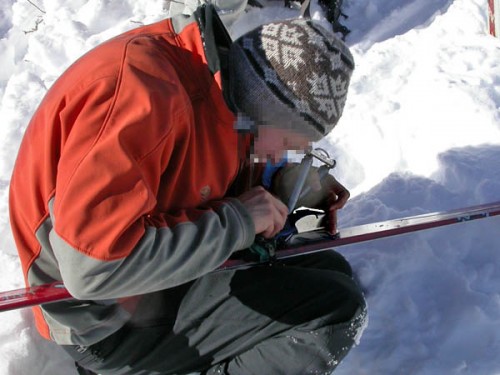
Field tuning ski gear is less than ideal, but often times necessary if you go on an extended trip with endless icy or gloppy conditions.  As with most expedition situations, inspiration is more important than perfection and the goal is to make due with what you have rather than packing extra gear.

Edges Sharpening
It is hard to believe until you try it, but those tiny little files on high-quality Multi-Tools do a passable job sharpening edges.

Wax Job
Skin wax also works as base wax if you rub it in.  Better yet, bring a block of regular warm weather wax and use that as skin wax.  It’s cheaper, multipurpose and works as well as “official” skin wax, which can be marginal depending on conditions.

Blown Binding Screws
Spare binding screws are the tiny cornerstone of a minimalist repair kit as they don’t weigh much and are virtually impossible to replicate in the field.  Loose screws can be tightened up by lining the stripped hole with tin foil, energy bar wrappers, chunks of a Space Blanket or any sort of tough, flexible film.  Steel wool works better yet if you happen to have it. The important part is to gently put the screw back in, as they are easily stripped.

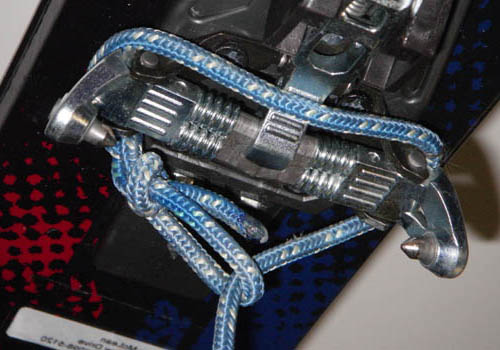
 Blown bindings are a bummer.
For such little parts, binding screws can have a huge impact on your day.

Tail Delams
Tail delaminations are the beginning of the end for a ski and even delams fixed in a shop are dubious.  In the field, the best you can do is to slow the delamination process by crudely screwing it back together, or stitching it with wire.  Tail delaminations are best avoided from the start by not throwing your skis off of cliffs you are downclimbing, hucking them across rivers or ramming them too hard into the snow for anchors.

JB Weld
There is almost nothing in the ski world which can’t be fixed with JB Weld.  It acts as a burly epoxy and can also be lumped on, then filed into shape for recreating broken plastic parts.  It requires a clean, dry surface and roughly 24 hours of warm temperatures to cure, which makes it impractical for day tours, but it is ideal for any trip over a three days.

________________________
15% off a Leatherman XE6 Multi-Tool (with file, pliers and scissors) from Backcountry.com


The 10 Minute Tune - Tools

Tuning backcountry skis is important, but doing a good job at it is not.  Backcountry skis take such daily abuse that you could easily spend more time tuning them than skiing on them if you insist on a perfect World Cup racing tune.  It is a matter of quantity, not quality, and the secret to quantity is to make it fast and easy.  Giving your skis a ten-minute quick tune every few times you take them out makes them a lot more fun and precise to ski on.

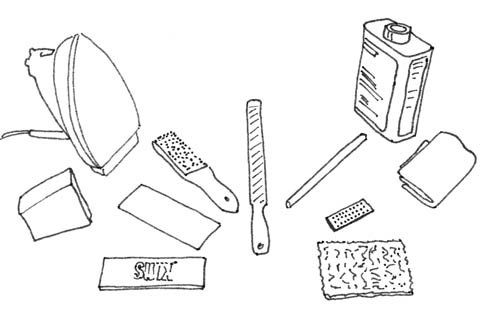
Stripped down tune-up only requires the most basic tuning tools.  The goal is to clean the bases, sharpen the edges, put some wax on them and give the bindings a visual safety inspection.

 A basic backcountry skiing tune-up kit.

Tools of the Quick-Tune Trade:

Rag
Base cleaner (lacquer thinner works)
Metal scraper
Plastic scraper
10″ file (worth getting a good one)
File card/brush
Medium Diamond Stone (coarse)
Wax (warm weather bulk wax)
Iron
Scotch-Brite pad
P-Tex repair sticks

For bulk wax, find a generic all purpose version as you never know what kind of conditions you’ll find in the backcountry.  On the file, even if the $20 version looks the same as the $8 one, the difference is in how hard they are.  Ski edges are heat-treated to a high Rockwell hardness rating which will ruin a cheap-o file in a tune or two. Even though it looks like you are getting a lot of metal filings with a cheap file, they are actually coming from the file, not the edges.

________________________
15% off a Swix starter kit from Backcountry.com

Vise Squad

Tuning (or trying to tune) a pair of skis without a bench and a vise is almost worse than not tuning them at all.  The skis fall over, you slice your hand, the wall gets scratched and the tune comes out marginal at best.  The backbone of a good tuning system is a solid bench and the heart of the system is a good ski vise. 

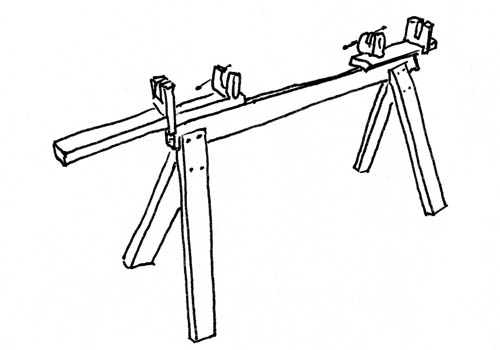
 A good place to start for a bench is a sawhorse.  These are nice as you can walk 360 degrees around them, and by trimming the legs down, you can operate on your skis at waist level, and thus apply more file/scraper pressure.  The basic set-up shown below is a wooden sawhorse with secondary chunks of 2 x 4″ pieces of wood screwed on top, then the vises mounted to that.  A bonus of the sawhorse bench is that it is also easy to clean up afterwards and it can be stored out of the way.

A good ski vise can be the most expensive part of a tuning kit, but they are essential, especially with rounded, shapey cap skis which are tricky to hold. 


Use blocks to help support the tips and tails.  If you have the technology (a saw), cut slots in the support blocks so you can plug your skis in sideways and work on the edges without having to clamp/unclamp them.  Close enough is good enough.

________________________
15% off ski tuning supplies from Backcountry.com

Toko DMT Diamond stones are a nice way to tell your skis “I love you.”